RAG
Chat App with RAG
Chat with your documents on a laptop with no accounts: hybrid search, a local reranker, answers with checked citations, PDFs, and retrieval, answers, and latency measured on frozen question sets.
Chat with your documents. Every answer cites the passages it came from, and when the documents don’t hold the answer, the app says so. It’s built on what rag-engineering measured about chunking, hybrid search, and reranking, and it runs on a laptop with no accounts and no API keys. OpenAI or Claude are a setting away.
What it does
npm start, then open http://127.0.0.1:3000:
- Collections: each one is a set of documents searched together.
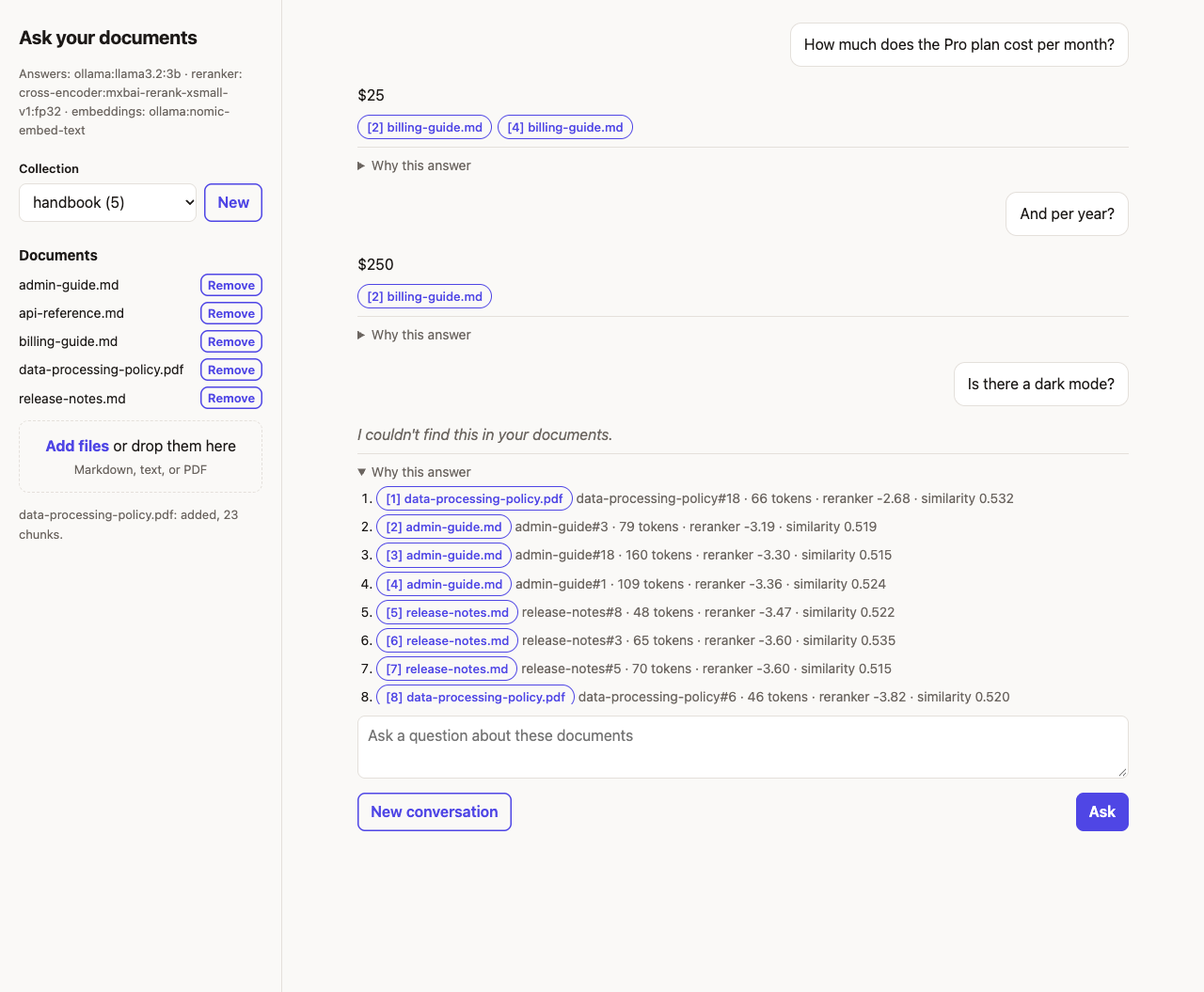
- Uploads: add Markdown, text or PDF files with the button, or drop them in. Each file is chunked and embedded as it arrives, so it can be searched straight away.
- Questions and follow-ups: a follow-up like “And per year?” is answered in the context of the conversation.
- Citations: each citation opens the cited passage, highlighted within the whole document.
- “I couldn’t find this in your documents” is said plainly. An answer whose citations couldn’t be checked is marked.
- Why this answer: under each answer, this shows the question that was searched for (when a follow-up was rewritten), every excerpt the model read with its reranker and similarity scores, which ones it cited, and how long each stage took.
Results at a glance
Measured on rag-engineering’s five product documents and its frozen questions, plus question sets written for this app. Each section below gives the setup and the command that reproduces it.
| What was measured | Result |
|---|---|
| Retrieval, against rag-engineering’s published numbers | 35 of 35 numbers reproduced exactly |
| Evidence found for 48 test questions within 1,000 tokens | 48 of 48 with the default (vector top 10, reranked), against 47 for hybrid search alone |
| Local cross-encoder against an LLM judge as reranker | the same 48 of 48 at 1,000 tokens, about 9 times faster |
Answers to the 48 test questions (llama3.2:3b, local) |
31 correct, 6 partly, 7 wrong, 4 declined; the evidence was in the excerpts for all 48 |
| 10 questions the documents don’t answer | 7 declined, 3 invented |
| The same documents as PDFs | 170 of 170 evidence passages kept; retrieval as good as on the Markdown |
| Question to answer, all local, on a laptop | a median of 2.1 s (90th percentile 2.8 s), of which the model’s answer is 1.7–1.8 s |
The weak point is the 3B model reading the excerpts, not retrieval. A larger model (OpenAI or Claude, through LLM_PROVIDER) may do better; that hasn’t been measured here.
Run it
Requires Node.js 24 or newer, and Ollama:
ollama pull nomic-embed-text
ollama pull llama3.2:3b
npm install
npm run models           # the reranker, 284 MB, checksums verified
npm start                # the app at http://127.0.0.1:3000
samples/remote-work-policy.pdf is a short document to try it with, and eval/documents/ holds the five used for the measurements.
npm install brings in ONNX Runtime for the reranker, and the dependency folder comes to about 520 MB. Without the reranker, RERANKER=none npm start uses hybrid search alone.
The server listens on 127.0.0.1 only. There are no accounts, so anyone who can reach the server can read and change its documents. Its API is described at the top of src/server.js.
Using OpenAI or Claude
Settings come from environment variables or a .env file; .env.example lists them all, with OpenAI and Claude examples. For example, to answer with Claude:
LLM_PROVIDER=anthropic LLM_API_KEY=your-anthropic-key npm startClaude is used for answers only, because Anthropic has no embeddings API. Embeddings can come from OpenAI (EMBEDDING_PROVIDER=openai-compatible); changing the embedding model re-embeds the documents.
Checks and measurements
npm run check            # lint and 78 tests; no network or models needed
npm run check:browser    # the web app end to end in headless Chrome, with the real models
npm run eval:retrieval   # retrieval on the frozen questions, against the published numbers
npm run eval:rerank      # reranking, likewise (the LLM judge takes about 10 minutes)
npm run eval:answers     # answers to the test questions; every reply saved for labelling
npm run eval:pdf         # the same documents as PDF: what extraction keeps
npm run measure:latency  # time per stage, on the test questions (refuses to run on battery)
npm run record:demo      # a screen recording of the app, driven in Chrome
The measurements count tokens with the Llama 3.2 tokenizer, as rag-engineering does, so the numbers can be compared with its published ones. The tokenizer file (17 MB) is under the Llama 3.2 Community License, so it isn’t stored in this repository. Download the same file rag-engineering uses, pinned to a revision, and check it:
mkdir -p models
curl -L -o models/tokenizer.json \
  https://huggingface.co/mlx-community/Llama-3.2-1B-Instruct-4bit/resolve/08231374eeacb049a0eade7922910865b8fce912/tokenizer.json
shasum -a 256 models/tokenizer.json   # 6b9e4e7fb171f92fd137b777cc2714bf87d11576700a1dcd7a399e7bbe39537b
Set TOKENIZER_PATH if you already have it elsewhere. Without it, the app estimates tokens at four characters each and works the same; the chunks just differ slightly from the measured ones.
How it works
question ─► rewrite a follow-up ─► embed ─► vector search ─► rerank the top 10 ─► fill 1,000 tokens
                                                                                        │
            answer + checked citations ◄─ check citation numbers ◄─ model replies in JSON ◄┘
Each stage is plain code you can read, with no RAG framework in between; that’s what lets the measurements below control each one.
- Chunking (
src/text/chunker.js): structure-aware chunks with the headings above each chunk copied in. This was the strategy that won rag-engineering’s chunking comparison: 29 of 29 test questions at a 1,000-token budget. It’s ported from there, and a test checks it makes exactly the same 98 chunks (10,913 tokens) on the same documents. - PDFs (
src/text/pdf.js): the text is extracted with PDF.js and rebuilt as Markdown (headings, paragraphs, table rows), so the same chunker works on it. Measured below. - Storage (
src/store/store.js): documents, chunks, and embeddings in one SQLite file, using Node’s built-innode:sqlite, so nothing native needs installing.- Documents are content-hashed: adding the same text again changes nothing, and changed text replaces the old chunks.
- Each embedding is stored with the name of the model that made it, and is redone when the model changes.
- Ids are never reused, so a citation can’t silently point at different text after a document changes.
- Retrieval (
src/retrieval/): four ways to rank chunks for a question, with the chosen chunks filling a token budget in rank order:- vector: cosine similarity of embeddings, exact and filtered to one collection before scoring;
- keyword: BM25, which returns only chunks sharing a word with the question;
- rrf: reciprocal rank fusion of the two (the default without a reranker);
- weighted: a weighted mix of the two scores.
- Reranking (
src/rerank/): a cross-encoder,mxbai-rerank-xsmall-v1(Apache-2.0), reads the question and each candidate together and reorders vector search’s top 10. It runs locally through transformers.js (ONNX Runtime), from files downloaded at a pinned revision and checked against their SHA-256s. - Answers (
src/answer/):- Rewrite a follow-up into a stand-alone question, so “Can we change that later?” retrieves the right passage.
- Retrieve and rerank the excerpts.
- Answer: the model replies in JSON with
answered,answer, and the numbers of the excerpts it used. The prompts are versioned inprompts.json. - Check the citations: each must be the number of an excerpt the model was actually given. An answer with no valid citation is flagged
uncited, not shown as sourced.
- Model providers (
src/providers/): answers from Ollama, OpenAI (or any OpenAI-compatible API), or Claude; embeddings from Ollama or OpenAI.- Ollama embeddings run with
truncate: false. By default Ollama silently cuts input longer than the model’s context, which in rag-engineering’s chunking measurements left the evidence for 9 questions unembedded. Here an over-long input is an error instead. nomic-embed-textgets itssearch_document:andsearch_query:prefixes added automatically.
- Ollama embeddings run with
- The web app (
src/server.js,public/): Node’s HTTP server and one page, no framework. Progress streams to the page as each stage starts. Uploads are size-limited and their names checked, and document text is only ever inserted into the page as text.
Retrieval, checked against the published numbers
npm run eval:retrieval runs rag-engineering’s 100 frozen questions through this app’s own code: its ingest, store, embeddings and retriever. It counts a question as found when every passage of one of its accepted answers is inside the chunks that fit the budget.
Every number matched the ones rag-engineering’s hybrid-search demo published for the same documents and model (35 of 35). Here are the 48 test questions, by budget:
| Method | 500 tokens | 1,000 tokens | 2,000 tokens |
|---|---|---|---|
| vector | 41 | 46 | 48 |
| keyword (BM25) | 41 | 45 | 46 |
| RRF | 45 | 47 | 47 |
| weighted (alpha 0.8) | 43 | 46 | 48 |
Recorded on 2026-11-16, on an Apple M4 Pro with Node 24.16.0, Ollama 0.40.16 and nomic-embed-text (0a109f422b47). The match holds whether the chunks are embedded fresh or read back from the database. Embedding a question took a median of 8–9 ms.
Reranking, measured
npm run eval:rerank reranks the first stage’s top 10 or 20 candidates, then fills the budget from the new order; a chunk outside the candidates is never used. As in rag-engineering’s reranking demo, it builds every (question, chunk) pair in the top 20 of either first stage, which is 2,581 pairs, and scores each pair once. It compares three ways of ordering the candidates:
- first stage: no reranking.
- LLM judge: the demo’s reranker.
llama3.2:3banswers Yes or No for each pair, and the score is the log-odds of its first token. - cross-encoder:
mxbai-rerank-xsmall-v1, new here.
The LLM judge reproduced the demo exactly. Every published number matched: candidate recall, evidence found by budget, and evidence found by question group. So the comparison below is like for like.
Evidence found for the 48 test questions:
| First stage → reranker | 500 tokens | 1,000 tokens | 2,000 tokens |
|---|---|---|---|
| RRF, no reranking | 45 | 47 | 47 |
| vector, no reranking | 41 | 46 | 48 |
| vector top 10 → LLM judge | 46 | 48 | 48 |
| vector top 10 → cross-encoder | 45 | 48 | 48 |
| vector top 20 → LLM judge | 45 | 47 | 48 |
| vector top 20 → cross-encoder | 44 | 47 | 48 |
| RRF top 10 → LLM judge | 44 | 47 | 47 |
| RRF top 10 → cross-encoder | 43 | 46 | 47 |
What this shows:
- The cross-encoder matches the LLM judge at the default budget of 1,000 tokens. Both find 48 of 48 when they rerank vector search’s top 10. At 500 tokens the cross-encoder finds one question fewer (45 against 46).
- The cross-encoder is much cheaper. It reranked 10 candidates in a median of 0.24 s. The LLM judge makes one call per candidate, at a median of 214 ms per call, so about 2.1 s for 10: about 9 times as long. The demo measured 166–184 ms per judge call; during this run a virtual machine was using most of one CPU core. (On battery, the day before: 0.26 s and 197 ms.)
- So the default is vector search’s top 10, reranked by the cross-encoder. It finds 48 at 1,000 tokens, against 47 for RRF without reranking.
- Reranking RRF’s candidates made results slightly worse with either reranker, as the demo found. RRF’s order was already good where it had the evidence. That’s why the app reranks vector search’s candidates instead.
- No candidate was truncated. The cross-encoder reads at most 512 of its own tokens per pair, and the longest of the 2,581 pairs was 503.
- The quantised model (q8) isn’t the default, though it’s a third of the size. It found the same questions here, but its score for a passage depended on which other passages were scored in the same batch: one passage scored −1.343 alone and −1.412 or −1.427 alongside others. That’s because its activations are quantised with a scale taken from the whole batch. So with it, a passage’s rank could depend on the other candidates. The full-precision model gave identical scores in any batch, and was no slower (0.24 s for 10 candidates, against 0.28 s). A test checks this.
Recorded on an Apple M4 Pro with Node 24.16.0, Ollama 0.40.16, nomic-embed-text (0a109f422b47), llama3.2:3b (a80c4f17acd5), transformers.js 4.3.2, and mxbai-rerank-xsmall-v1 at revision b5c6e9da: first on 2026-11-16 on battery power, then on 2026-11-17 on mains power. Every count was identical in both runs; the timings above are from the run on mains power.
Answers, measured
The answer prompt is rag-engineering 04’s docs-v1, which was measured on these documents, with numbered excerpts and citations added (docs-cited-v1).
Two new question sets were written for this app, and frozen before any answer was generated:
- 20 questions the documents don’t answer (
not-in-docs.json), all near misses, such as a calendar view or a Python client library. Draft questions the documents turned out to answer were dropped. - 8 two-turn conversations (
follow-ups.json).
Choices were made on the development questions, and the results are reported on the test questions. npm run eval:answers -- --split test reproduces them: temperature 0 and a fixed seed give the same 66 replies on every run.
Results on the test questions, using llama3.2:3b (local), the default retrieval (vector top 10, reranked, 1,000 tokens), numbered citations, and no gate. The replies were labelled by reading each one against the question’s reference answer, by Claude (the AI assistant that wrote this code), and haven’t yet been reviewed by the repository’s owner. The labels, and a note for each reply that isn’t correct, are in eval/labels/answers-test.json, keyed to a hash of the exact reply.
| 48 answerable questions | |
|---|---|
| correct | 31 |
| partly correct (missing a detail the reference has) | 6 |
| wrong | 7 |
| declined | 4 |
| 10 questions the documents don’t answer | |
|---|---|
| declined | 7 |
| answered anyway (all three invented) | 3 |
What these results show:
-
The errors are the model’s, not retrieval’s. The evidence was in the excerpts for all 48 answerable questions. The wrong answers misread an excerpt that was there: for example, saying the audit log isn’t kept after a downgrade when the excerpt says it is.
-
The same comparison as rag-engineering 04. On its 29 test questions, its pipeline with
docs-v1got 22 correct, 2 wrong, and 5 declined. This pipeline gets 23 correct, 4 wrong, and 2 declined: it answers more often, and is wrong a little more often. -
The model doesn’t always cite the excerpt it used. Every citation number was valid, but the cited excerpts contained the evidence for only 27 of the 44 answered questions. Many of the other answers were right but cited a neighbouring excerpt. You can see this in the app: asked “How much does the Pro plan cost per month?”, it answers $25 and cites two passages, only one of which has the price.
- Asking for exact quotes instead of numbers (
CITATIONS=quotes, promptdocs-quoted-v1) makes a citation checkable by construction, because each quote is found in the excerpt it came from. On the development questions it raised cited evidence from 33 to 38 of 50. But it also doubled the invented answers to unanswerable questions, from 2 to 4 of 10, and was slower (median 2.1 s against 1.5 s). The rule fixed before the comparison kept numbers.
- Asking for exact quotes instead of numbers (
-
The relevance gate is off by default. It declines a question without asking the model when even the best excerpt scores below a threshold. The threshold was tuned on the development questions: the highest that blocks no answerable one.
- On the development questions, neither gate caught an unanswerable question the model would have answered. Every one it blocked, the model declined anyway, which rag-engineering 03 also found.
- On the test questions:
- the gate on the best reranker score would have caught 2 invented answers, but wrongly blocked 3 answerable questions that were answered correctly or partly;
- the gate on vector similarity would have caught 1, and blocked nothing it shouldn’t.
GATE=vectorturns it on. -
Rewriting follow-ups retrieved the evidence for 7 of the 8 conversations, against 6 when the follow-up was used as asked. That’s too few to show an effect. The one change it made mattered, though: “Can we change that later?” became “Can we change the data region later?”, and a confident wrong answer about something else became a decline. The 3B model sometimes left a follow-up unchanged (“And per year?”).
The model’s answer took a median of 1.5 s in this evaluation (2026-11-17, on mains power), and 1.7–1.8 s in the latency runs below.
PDF documents, measured
src/text/pdf.js extracts a PDF’s text with PDF.js (pdfjs-dist, Apache-2.0). It rebuilds the text as Markdown, so the structure-aware chunker works the same way on it:
- Headings: a line set at least 15% larger than the body text becomes a heading, with levels assigned by size.
- Paragraphs: lines that wrapped inside a paragraph are joined back into one.
- Tables: a gap inside a line wider than 0.9 times the font size separates two columns, and the table is rebuilt cell by cell.
A PDF with no text, such as a scan, is refused with a reason rather than stored empty.
eval/pdf/ holds the five evaluation documents as PDFs. They were rendered from the Markdown and printed to A4 by Google Chrome (scripts/make-eval-pdfs.js). npm run eval:pdf compares them with the Markdown originals. Text is compared with Markdown symbols, spacing and case ignored on both sides, so a table row read from the PDF (“Annual price | $100 | $250”) matches its Markdown source. On the Markdown, this gives exactly the published numbers.
| Markdown | ||
|---|---|---|
| evidence passages present in the extracted text | 170 of 170 | 170 of 170 |
| headings | 121 | 121 (all recovered, at the right levels) |
| chunks / tokens | 98 / 10,913 | 98 / 10,664 |
| test questions found, vector top 10 → reranker (500 / 1,000 / 2,000 tokens) | 45 / 48 / 48 | 46 / 48 / 48 |
| test questions found, RRF (500 / 1,000 / 2,000 tokens) | 45 / 47 / 47 | 45 / 47 / 47 |
Two things were hard, and both were found by measuring:
- Table cells that wrap. In a PDF, a cell that wraps onto a second line is drawn as two separate pieces of text. Joining each visual line from left to right mixes up the cells: “The response wasn’t signed with an Add the identity provider’s current active certificate certificate (section 4.4)”. The first version of the extractor did exactly this, and lost 5 of the 170 evidence passages (44, 46 and 46 test questions found instead of 46, 48 and 48). Now pieces of one row that start at the same position belong to one cell, and each cell is read top to bottom. PDF.js also adds whitespace-only pieces that span the gap between cells; those are ignored when measuring gaps, or no gap would be seen at all.
- Monospaced fonts. The column threshold was first 0.45 times the font size, because a word space in a proportional font is about a quarter of it. But a monospaced font’s space is 0.6, so in a PDF set in one, every word became a column of its own, and the text came back as a jumble of table cells. That happened to the old sample document in
samples/(made by macOS, not Chrome), and to every code block in the evaluation API reference. Measured across all six PDFs, gaps between words are 0 to 0.6 times the font size and gaps between table cells are 1.15 or more, so the threshold is now 0.9. The evaluation numbers above didn’t change, and tests cover both cases.
What these PDFs don’t cover. They’re clean, digitally made PDFs: one column, real text, consistent fonts. Real PDFs can be harder, with scans (no text at all), two-column layouts, text drawn as images, headers and footers repeated on every page, or tables without borders. Those aren’t measured here. A PDF whose text was broken mid-word at the end of each line (as the sample’s is) keeps the break: “Northwind La bs”.
Latency, measured
npm run measure:latency sends the test questions through the app’s own pipeline with the default settings, one after another: the 48 answerable questions, the 10 the documents don’t answer, and the second turn of the 4 test follow-up conversations, 62 in all. It was run twice, back to back:
| Stage, median / 90th percentile | Run 1 | Run 2 |
|---|---|---|
| rewrite a follow-up (the 4 follow-ups only) | 353 / 519 ms | 298 / 401 ms |
| embed the question | 13 / 23 ms | 12 / 18 ms |
| score every chunk, vector and BM25 (98 chunks) | 0.7 / 1.3 ms | 0.6 / 1.1 ms |
| rerank 10 candidates | 382 / 677 ms | 299 / 557 ms |
| the model’s answer | 1,687 / 2,104 ms | 1,784 / 2,393 ms |
| total | 2,098 / 2,816 ms | 2,137 / 2,793 ms |
What this shows:
- About 2.1 s from question to answer, and the model’s answer is most of it. The replies are short (a median of 27 output tokens), while the prompt carries up to 1,000 tokens of excerpts. So reading the prompt is likely the larger part, but the two weren’t timed separately.
- Searching costs almost nothing at this size: under 1 ms to score all 98 chunks exactly. Exact search grows with the number of chunks; collections much larger than these five documents weren’t measured.
- Reranking is the second cost, at 0.3–0.4 s. The reranking evaluation scored the same 10 candidates in 0.24 s, back to back; inside the app, alternating with the model’s calls, it was slower. The cause wasn’t isolated.
- A follow-up costs one more model call, to rewrite it: about 0.3 s.
- The first question after a start is slower: 4.5 s and 3.1 s in the two runs. Loading the reranker took 350–375 ms; most of the rest was Ollama loading
llama3.2:3b. - Answers aren’t streamed word by word. The reply is JSON whose citations are checked before it’s shown, so the page shows each stage’s progress instead.
Recorded on 2026-11-17 on an Apple M4 Pro on mains power, with Node 24.16.0, Ollama 0.40.16, llama3.2:3b (a80c4f17acd5), nomic-embed-text (0a109f422b47), and mxbai-rerank-xsmall-v1 at full precision. No other work was running except a virtual machine using most of one CPU core; the one-minute load average was between 4.2 and 8.2. An earlier run, made during a video call (load average up to 13.6), was discarded. Timings on other machines will differ; the script records its setup in results/latency.json.
Evaluation data
eval/ holds rag-engineering’s corpus (five fictional product documents) and its frozen question sets, copied from that repository at commit d569efa (MIT, same author):
chunking.json: 60 questions;hybrid-search.json: 40 questions, also used for reranking.
Every question names the passages that answer it, which is how retrieval is scored. The question sets written for this app are described above, and the PDF versions of the documents here.
History
Until November 2026 this repository held a simpler app: Next.js, Express and Weaviate, one PDF at a time, word-based chunks, top-3 vector search, and no citations. It’s preserved at commit f80e8ae. This version replaced it, step by step, on what rag-engineering measured.
Licence
MIT.
From the repository's README on GitHub, synced Nov 17, 2026.